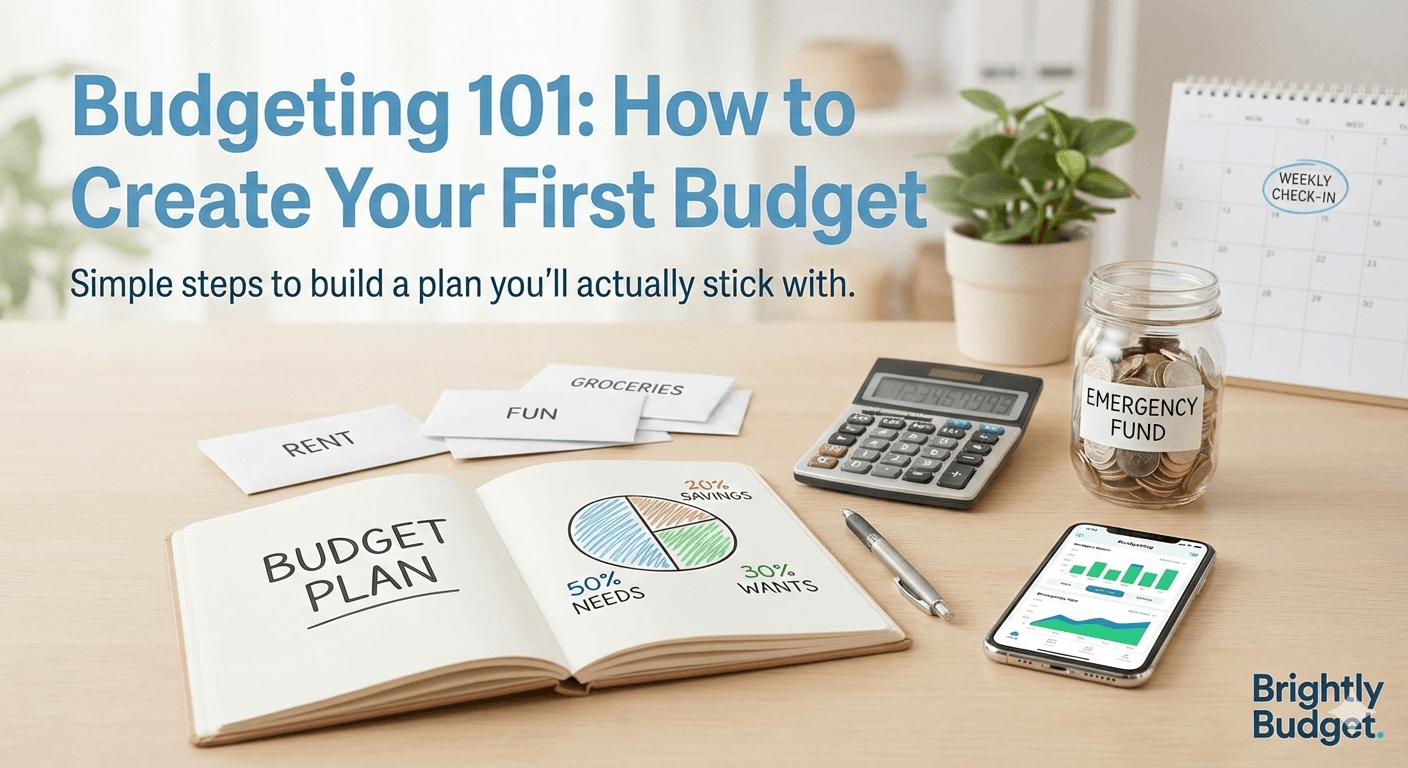
Budgeting 101: How to Create Your First Budget
If “budgeting” makes you picture spreadsheets, guilt, and canceling everything fun… you’re not alone.
But a budget isn’t a punishment. It’s a plan—a way to decide ahead of time what your money should do, so you’re not guessing at the end of the month.
This guide walks you through building a first budget that’s simple, realistic, and easy to maintain.
What a budget is (and what it isn’t)
A budget is:
- A set of choices about your money
- A tool to reduce stress and surprise expenses
- Something you update as life changes
A budget is not:
- A strict set of rules you “fail” if you overspend once
- A promise you’ll never buy coffee again
- A one-time project you do and forget
Step 0: Pick a “good enough” tool
Start with the tool you’ll actually open weekly:
- Notes app or paper
- Spreadsheet
- A budgeting app (especially helpful if it auto-categorizes transactions)
The best budget system is the one you’ll use consistently.
Step 1: Choose your budget timeframe
Most people start with a monthly budget (rent and bills are monthly). If you’re paid weekly or biweekly, you can still budget monthly—just do a quick check-in on payday.
Step 2: Know your monthly income
Write down take-home income (after taxes/deductions).
If your income varies:
- Use your “safe number” (your lower/typical month), or
- Use an average, but keep a buffer (ex: average minus 5–10%)
Step 3: List your “must pay” expenses
These are the bills that keep life running:
- Housing (rent/mortgage)
- Utilities
- Insurance
- Transportation basics
- Debt minimum payments
- Childcare (if applicable)
Pro tip: Don’t guess. Pull up last month’s transactions and copy real numbers.
Step 4: Estimate variable spending (the “flex” categories)
Common variable categories:
- Groceries
- Eating out
- Gas/public transit
- Shopping
- Entertainment
- Personal care
If you’re brand new, start with 10–15 categories total. Too many categories makes budgeting feel like homework.
Step 5: Add “true expenses” (the budget breakers)
True expenses are irregular—but predictable—costs like:
- Car repairs/maintenance
- Gifts and holidays
- Annual subscriptions
- Medical copays
- Travel
- Back-to-school, seasonal costs
If you don’t budget for true expenses, your budget will feel “broken” a few times per year. Instead, set up a sinking fund: a small amount each month so the bill doesn’t wreck you later.
Example: If holiday gifts cost ~$600/year, set aside $50/month.
Step 6: Pick a simple budgeting framework
Two beginner-friendly frameworks:
Option A: The 50/30/20 guideline
A loose guide:
- 50% Needs (housing, utilities, basic groceries, minimum debt payments)
- 30% Wants (fun, dining out, hobbies)
- 20% Savings/Debt (extra debt payoff, emergency fund, savings)
This is a guideline—not a grade. If your “needs” are currently 60% because rent is expensive, you’re not failing. You’re getting clarity.
Option B: “Every dollar has a job”
Also called zero-based budgeting. You assign all money a purpose so nothing disappears accidentally. (We’ll go deeper on this in another post.)
Step 7: Build your first draft (example)
Here’s an example with $4,000/month take-home income:
| Category | Monthly Target |
|---|---|
| Income | $4,000 |
| Housing | $1,250 |
| Utilities + internet/phone | $250 |
| Groceries | $350 |
| Transportation | $150 |
| Insurance (monthly average) | $0 (included above / adjust as needed) |
| Needs subtotal | $2,000 |
| Eating out | $250 |
| Entertainment | $150 |
| Shopping | $200 |
| Travel sinking fund | $200 |
| Gym/hobbies | $100 |
| Fun money / misc | $300 |
| Wants subtotal | $1,200 |
| Emergency fund | $300 |
| Extra debt payoff | $300 |
| Other savings (future goals) | $200 |
| Buffer (misc/true expenses) | $0 (or add if needed) |
| Savings/Debt subtotal | $800 |
Make this yours. If “groceries” is your problem category, give it more attention and a realistic number.
Step 8: The 10-minute weekly budget habit
Budgets work when you check them regularly. Once per week:
- Look at spending by category
- Adjust what’s left for the week
- Move money between categories if needed (without guilt)
Common beginner mistakes (so you can skip them)
- Forgetting true expenses (then feeling like budgeting “doesn’t work”)
- Being too strict (no fun money = burnout)
- Tracking too much (keep categories simple)
- Not reviewing weekly (a budget without check-ins becomes wishful thinking)
- No buffer (even $25–$50 helps)
Quick-start checklist
- [ ] Track last month’s spending
- [ ] Pick 10–15 categories
- [ ] Add a true-expense sinking fund
- [ ] Set 10-minute weekly review on your calendar
- [ ] Keep a small “fun money” category so the budget is livable
Disclosure: This post is for educational purposes and isn’t financial advice.